

Should You Sell Gummies, Capsules, Powders, Tablets, or Liquids? Pros, Cons, and Strategy Guide for Supplement Brands

5 days ago
12 min read
Updated: 14 hours ago

Launching or scaling a nutraceutical brand brings you face-to-face with a fundamental crossroad: How should your customers consume your product?
Choosing between gummies, capsules, powders, tablets, and liquids is not merely an aesthetic choice or a simple packaging preference. It is a core strategic decision that directly impacts your formulation capabilities, production costs, shipping logistics, consumer compliance, active bioavailability, and profit margins.
Pick the right delivery system for your target demographic, and you create an addictive daily habit that fuels high subscription retention. Pick the wrong delivery format, and you may face melting inventory in hot transit, degraded active ingredients, excessive shipping freight, or a product that consumers struggle to swallow.
In this deep-dive guide, we explore the objective pros, cons, formulation science, and market realities of all five major supplement delivery formats. By the end, you will possess the exact framework needed to select the optimal dosage format for your product line and know how to turn that choice into a commercial success.
The Evolving Landscape of Supplement Delivery Systems
To understand where the dietary supplement market is heading, you must first understand how consumer expectations have transformed over the last decade. Historically, the global nutraceutical market was dominated by hard pressed tablets and traditional two-piece hard-shell capsules. They were efficient to manufacture, highly shelf-stable, and cost-effective.
However, modern wellness consumers have reshaped product development priorities. According to industry analytics from Grand View Research, the global dietary supplements market size was valued at USD 177.3 billion in 2023 and is projected to expand at a compound annual growth rate (CAGR) of 9.1% through 2030. A massive driver of this growth is the diversification of delivery formats.

Modern buyers frequently suffer from pill fatigue, a genuine psychological barrier where taking daily wellness products feels too much like taking prescription medication. As a result:
Gummies have experienced rapid double-digit growth, moving far beyond pediatric health into adult beauty, sleep, stress relief, and functional wellness.
Powders have surged thanks to active nutrition, collagen peptides, hydration mixes, and functional greens where required daily dosages are far too large for pills.
Capsules remain the gold standard for clinical-grade, high-potency, clean-label, and target-specific formulations.
Tablets continue to dominate high-density mineral blends, chewables, sublinguals, and effervescent daily multivitamin lines.
Liquids and Liposomals are carving out premium market share for consumers seeking rapid absorption, easy micro-dosing, or zero-swallowing friction.
Let's dissect each delivery mechanism in detail.
1. Gummy Supplements: The Consumer-Favorite Powerhouse
Gummies have reshaped the consumer nutraceutical space over the past decade. By transforming daily health maintenance into a delicious chewable treat, gummies have unlocked demographic groups that previously resisted traditional daily supplements.

The Pros of Manufacturing Gummies
a) High Consumer Compliance and Habit Loops
The central challenge for any direct-to-consumer (DTC) or retail supplement brand is customer lifetime value (LTV) and monthly reorder rates. If a consumer buys a bottle of unappealing pills and forgets to take them, reorder rates plummet. Gummies tap into human reward pathways. Because they taste good, consumers look forward to taking them every day, leading to higher daily compliance and consistent monthly subscription retention.
b) Solves "Dysphagia" (Difficulty Swallowing)
Dysphagia affects an estimated 15% to 20% of older adults and a substantial percentage of children. Gummies eliminate this barrier entirely, making health wellness accessible to broad consumer segments who physically cannot or prefer not to swallow hard pills.
c) Viral Visual Appeal & Social Marketing
Gummies excel on visual marketing channels like TikTok, Instagram, and Amazon storefronts. Bright colors, appealing fruit shapes, and chewable textures generate higher impulse-buy conversion rates compared to utilitarian brown bottles of standard capsules.
The Cons & Challenges of Gummies
a) Payload Limitations
A standard commercial gummy weighs between 2.5 grams and 4.0 grams. The vast majority of that physical weight is reserved for the gelling matrix (pectin or gelatin), liquid sweeteners, texturizers, citric acid, and natural flavors. This leaves a small fraction, often only 100 mg to 300 mg, for active ingredients. If your formulation requires 5,000 mg of amino acids or 3,000 mg of Magnesium, a customer would need to consume 15 to 20 gummies daily, destroying the economic and health value proposition.
b) Thermal Degradation and Overages
Active botanical extracts, heat-sensitive vitamins (like Vitamin C and B-complex), and delicate bio-actives degrade rapidly when exposed to the high cooking temperatures and moisture levels of gummy depositing lines. Contract manufacturers are often forced to include "overages" (adding higher initial raw ingredient input) to guarantee label claims throughout the shelf-life, which increases raw material costs.
c) Heat and Freight Sensitivity
Gummies are physically vulnerable to ambient temperature swings during transport. Shipping non-refrigerated gummies during summer months or through hot fulfillment zones can cause melting, clumping, and sticking, triggering costly product returns and negative customer reviews.
d) Sugar and Clean-Label Concerns
Traditional gummies rely on glucose syrup and cane sugar. While pectin-based sugar-free gummies using natural sugar alcohols or stevia are increasingly popular, formulating sugar-free gummies without compromising mouthfeel, clarity, or gastrointestinal tolerance requires advanced processing equipment.
2. Capsule Supplements: The Clinical, Clean-Label Gold Standard
When health-conscious buyers seek high-potency, targeted nutritional results, they look to capsules. Two-piece hard-shell capsules remain the most versatile, reliable, and scientifically respected delivery format across the global health industry.

The Pros of Manufacturing Capsules
a) Maximum Formulation Purity & Payload Efficiency
Unlike gummies or flavored drink powders, capsules require zero masking agents, heavy sweetener systems, acidulants, or artificial flavors. Nearly 100% of the internal volume of a Size 00 or Size 000 capsule can be dedicated to pure active ingredients. This makes capsules the ideal vehicle for high-potency herbs like Ashwagandha, Berberine, or complex multi-strain Probiotics.
b) Unmatched Shelf Stability & Moisture Protection
Hard-shell capsules isolate powdered bio-actives from ambient oxygen, humidity, and light. With specialized options like delayed-release or acid-resistant HPMC shells, manufacturers can protect sensitive bio-actives (such as digestive enzymes or live probiotic cultures) from stomach acid so they dissolve safely inside the intestinal tract.
c) Fast Manufacturing & Lower MOQs
Encapsulation machinery runs at high speeds with minimal thermal waste. Compared to the specialized cooking, depositing, and curing infrastructure required for gummies, capsule manufacturing generally carries lower Minimum Order Quantities (MOQs) and lower cost-per-unit metrics, allowing emerging brands to enter the market with manageable capital expenditure.
d) Strict Clean-Label Alignment
Capsules easily support key dietary certifications: Vegan, Vegetarian, Kosher, Halal, Non-GMO, and Keto. Using HPMC (hydroxypropyl methylcellulose) plant-derived shells, brands can market clean-label products free from excipients, synthetic binders, or artificial additives.
The Cons of Capsules
a) Pill Fatigue
Asking consumers to swallow 4 to 6 large capsules every morning creates routine friction. Buyers taking multiple daily supplements often actively look for alternative formats to lighten their pill burden.
b) Serving Size Limits for Bulk Ingredients
While a single Size 00 capsule holds roughly 600 mg to 800 mg of powder (depending on bulk density), formulas requiring multi-gram daily doses (such as 5,000 mg of Creatine or 10,000 mg of Collagen) require taking 8 to 12 capsules per serving, which becomes unpractical for daily consumer use.
3. Powder Supplements: High-Dosage, High-Performance Utility
Powder supplements drive the sports nutrition, active performance, hydration, and functional food categories. From pre-workout blends and meal replacements to green superfoods and electrolyte mixes, powders dominate high-volume ingredient delivery.

The Pros of Manufacturing Powders
a) Unrestricted Active Dose Capacity
Powders eliminate physical payload boundaries. If your formula requires 10,000 mg of amino acids, 5,000 mg of electrolytes, and 3,000 mg of herbal extracts, a single 20-gram scoop handles the entire payload easily. This makes powders the premier choice for bulk-dose performance formulas.
b) Customizability for the End User
Powders allow consumers to adapt their dosage experience. Users can adjust their scoop size, mix the formula into water, milk alternatives, or smoothies, and seamlessly integrate the product into their pre-existing culinary habits.
c) Flexible Packaging Options
Powders can be packaged in high-density polyethylene (HDPE) tubs, eco-friendly stand-up pouches, or convenient single-serve stickpacks. On-the-go stickpacks combine the dose capacity of powders with the lifestyle convenience of portable single-serve formats.
d) High Perceived Value & Margins
A 500-gram tub of powder often commands premium retail price points ($50 to $80+ CAD/USD) while offering strong profit margins per serving due to high-throughput automated dry-blending and high-speed filling lines.
The Cons of Powders
a) Complex Flavoring and Masking Engineering
Botanical extracts, raw minerals, and amino acids are naturally bitter, astringent, or metallic. Developing an appealing powder product requires advanced flavor development to balance sweetness, mouthfeel, and aroma without overwhelming the consumer with artificial chemicals.
b) Operational Consumer Friction
Unlike a gummy or capsule that can be swallowed instantly anywhere, powders require a liquid source, a shaker cup or glass, and clean-up effort. This operational step can reduce daily compliance if the consumer is commuting or traveling.
c) Clumping and Hygroscopic Risks
Hygroscopic (moisture-absorbing) active ingredients can clump over time if the formulation lacks proper anti-caking agents or protective induction-sealed packaging with desiccants. Furthermore, if a powder exhibits poor solubility in cold water, consumers will complain about gritty textures.
4. Tablet Supplements: The High-Density, Low-Cost Classic
Tablets remain one of the most widely produced delivery systems in the pharmaceutical and nutraceutical industries. By compressing dry powder blends under extreme mechanical pressure, tablets pack large amounts of dense active ingredients into a compact physical form.

The Pros of Manufacturing Tablets
a) Exceptional Cost Efficiency at Scale
Rotary tablet presses operate at rapid speeds, stamping out tens of thousands of units per hour. For high-volume production runs, tablets offer one of the lowest manufacturing costs per unit of any oral dosage form.
b) Superior Density and Compact Size
Heavy mineral salts, such as Calcium, Magnesium, Carbonate, and Zinc, have high bulk densities that take up significant space in capsules. Direct compression presses reduce this volume, fitting 1,000 mg or more of dense material into a manageable tablet profile.
c) Versatile Advanced Delivery Technologies
Tablets offer technical flexibility that other dry formats cannot match:
Chewable Tablets: Ideal for child and adult multivitamins with pleasant fruit flavors.
Effervescent Tablets: Dissolve quickly in water to create a sparkling, bioavailable drink.
Sublingual Tablets: Dissolve under the tongue for direct mucosal absorption (e.g., Vitamin B12 or Melatonin).
Bi-Layer / Multi-Layer Tablets: Combine two incompatible ingredients in separate layers or combine a fast-release layer with an extended-release layer in a single dose.
d) Extended Shelf Life & Coating Protections
Film coatings, aqueous coatings, and enteric coatings safeguard tablets from ambient humidity and air while smoothing the outer surface for easier swallowing and masking unpleasant internal tastes.
The Cons of Tablets
a) Swallowing Difficulty (Deglutition Friction)
Large, dense, uncoated tablets can feel rough or heavy when swallowed, causing throat friction that turns away consumers prone to pill fatigue.
b) Need for Binders and Excipients
Compressing raw powder into a firm tablet that resists breaking during packaging requires functional excipients, such as microcrystalline cellulose, binders, lubricants (like magnesium stearate), and disintegrants. Brands targeting 100% additive-free clean labels may find tablet formulation requirements more complex than simple two-piece encapsulation.
c) Disintegration Variations
If a tablet is over-compressed or lacks proper disintegrants, it may pass through the digestive tract without breaking down fast enough to release its active payload effectively.
5. Liquid Supplements: High Bioavailability & Rapid Absorption
From concentrated sublingual droppers and liposomal elixirs to ready-to-drink (RTD) wellness shots and liquid collagen, liquid supplements represent a dynamic, high-growth market segment.

The Pros of Manufacturing Liquids
a) Rapid Absorption & High Bioavailability
Liquid supplements bypass the mechanical breakdown step required for tablets and capsules. Active ingredients are already dissolved or suspended in solution, allowing faster availability for gastrointestinal uptake. Advanced formats, such as liposomal liquids, encapsulate active molecules in phospholipid spheres to protect them through stomach acid and boost cellular absorption.
b) Zero Swallowing Barriers
Liquid drops, syrups, and shots eliminate swallowing hesitation entirely. They are popular for pediatric formulations, senior care products, and clinical recovery lines where patients struggle with solid pills.
c) Precision Micro-Dosing
Liquid droppers and calibrated cups allow consumers or healthcare practitioners to adjust dosage amounts effortlessly down to the exact drop or milliliter, accommodating customized health regimens.
d) Premium Market Positioning
Liquid elixirs, functional botanical drops, and liposomal shots frequently command high retail margins, appealing to premium wellness buyers searching for fast-acting, high-potency products.
The Cons of Liquids
a) Microbial Vulnerability & Preservative Needs
Water-based liquid environments are susceptible to bacterial, fungal, and yeast contamination. Liquid manufacturing demands strict cleanroom processing, cold-fill or hot-fill pasteurization, and effective natural or food-grade preservative systems (such as potassium sorbate, citric acid, or glycerin) to preserve shelf stability.
b) Shipping Weight and Logistics Costs
Water and glass packaging add physical weight and volume. Shipping liquid products across e-commerce networks incurs higher freight costs, demands durable protective packaging to prevent breakage, and increases transit carbon footprints compared to light dry powders or capsules.
c) Post-Opening Shelf Life & Storage
Many liquid formulations require refrigeration once unsealed and carry shorter shelf-life windows after opening compared to stable dry capsules or tablets.
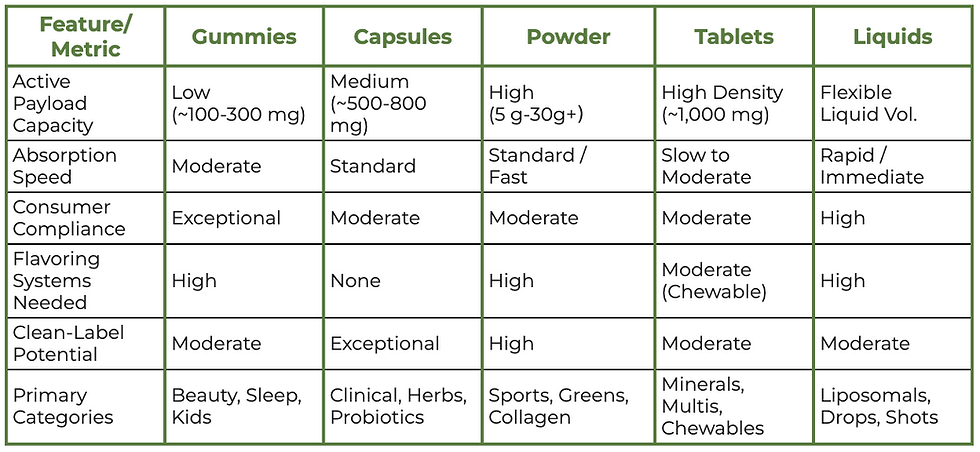
5-Way Strategic Head-to-Head Comparison
To evaluate your brand's options across all five delivery systems, review the side-by-side technical trade-offs below:
Strategic Decision Tree: Which Delivery System Fits Your Brand?
When deciding on the right format for your product launch, evaluate your choices against these primary criteria:

Real-World Strategic Examples:
Scenario A: A High-Potency Nootropic Formula
Ingredients: Alpha-GPC, L-Theanine, Bacopa Monnieri.
Target Audience: Professionals, students, and cognitive performance seekers.
Best Choice: Capsules. The demographic values precise dosing, zero sugar, fast action, and clean labels. Herbal bitterness is contained neatly inside the capsule shell.
Scenario B: A Daily Beauty-From-Within Routine
Ingredients: Biotin, Vitamin C, Zinc, Hyaluronic Acid.
Target Audience: Social-first lifestyle and beauty shoppers.
Best Choice: Gummies. Active doses are small, routine compliance improves with a tasty daily treat, and bright aesthetic styling drives visual social media engagement.
Scenario C: Electrolyte & Intra-Workout Recovery
Ingredients: Potassium, Sodium Citrate, BCAA, L-Glutamine.
Target Audience: Endurance athletes and fitness enthusiasts.
Best Choice: Powder Stickpacks. Total active payload exceeds 8 grams per serving. Single-serve stickpacks deliver high portability, fast hydration, and flexible mixing.
Scenario D: High-Dose Bone & Joint Mineral Complex
Ingredients: Calcium Carbonate, Magnesium Oxide, Vitamin D3, Zinc.
Target Audience: Value-oriented daily wellness buyers.
Best Choice: Tablets. Dense minerals compress efficiently into compact film-coated tablets, maintaining high product yield and low unit costs.
Scenario E: High-Bioavailability Liposomal Vitamin C
Ingredients: Sodium Ascorbate wrapped in Sunflower Lecithin Phospholipids.
Target Audience: Premium health seekers and immune-support buyers.
Best Choice: Liquid. Liposomal liquid suspensions protect delicate actives through gastric transit while delivering rapid cellular absorption.
Why Vedic Ventures Nutraceuticals is Your Ultimate Manufacturing Partner

Selecting the right delivery format is only half the equation. Bringing a stable, regulatory-compliant, market-ready supplement line to store shelves or e-commerce platforms requires an experienced contract manufacturing partner who can handle complex production requirements across multiple product lines.
At Vedic Ventures Nutraceuticals Inc., we serve as a premier turnkey contract manufacturing, formulation, and product development partner for emerging and enterprise supplement brands across Canada, the United States, and international markets.
Here is how Vedic Ventures elevates your product line:
Comprehensive Multi-Format cGMP Manufacturing: Operating within Health Canada site-licensed, FDA-registered, and cGMP-compliant facilities, we handle high-speed encapsulation, automated precision dry-blending, tablet pressing, softgels, liquid compounding, and custom pectin gummy production under one roof.
Enterprise Production Capacity: With monthly manufacturing capabilities exceeding 20 million individual units, we provide the scale and flexibility your brand needs to expand smoothly from initial commercial runs to major retail distribution without supply chain interruptions.
In-House Regulatory & NPN Mastery: Navigating Health Canada NPN licensing and US FDA dietary supplement regulations can slow down product rollouts. Our dedicated regulatory team brings over 25 years of hands-on experience, overseeing Class 1, 2, and 3 NPN applications, monograph reviews, and formula gap analyses to ensure full market compliance.
Advanced R&D and Flavor Development: Whether you need to mask bitter botanicals in a custom performance powder, develop stable delayed-release vegetarian capsules, compress dense mineral tablets, or manufacture clean sugar-free pectin gummies, our master formulators engineer products for maximum efficacy, stability, and consumer taste.
Turnkey Packaging & 3PL Logistics Support: Production is only the first step. Vedic Ventures offers comprehensive packaging capabilities, including HDPE bottles, glass droppers, blister packing, stand-up pouches, and single-serve stickpacks, alongside climate-controlled warehousing and cross-border logistics to support your brand end-to-end.


